
"Which era built the best houses?" is one of the most common questions home inspectors get. The honest answer: every era has its strengths, and every era has something hiding in the walls, the ground or the attic. Knowing which one you're looking at tells you what to ask, what to budget for, and what might make the home harder to insure.
This guide walks through 100 years of Edmonton homebuilding, era by era. It's built on a talk David Bier of North49 Home Inspections gave at our REMAX River City sales meeting, plus the questions I ask on behalf of my buyers.
Part of my series on the 8 things to check so you don't regret buying in Edmonton. Watch the 30-second video version on Instagram, and save this post for your house hunt.
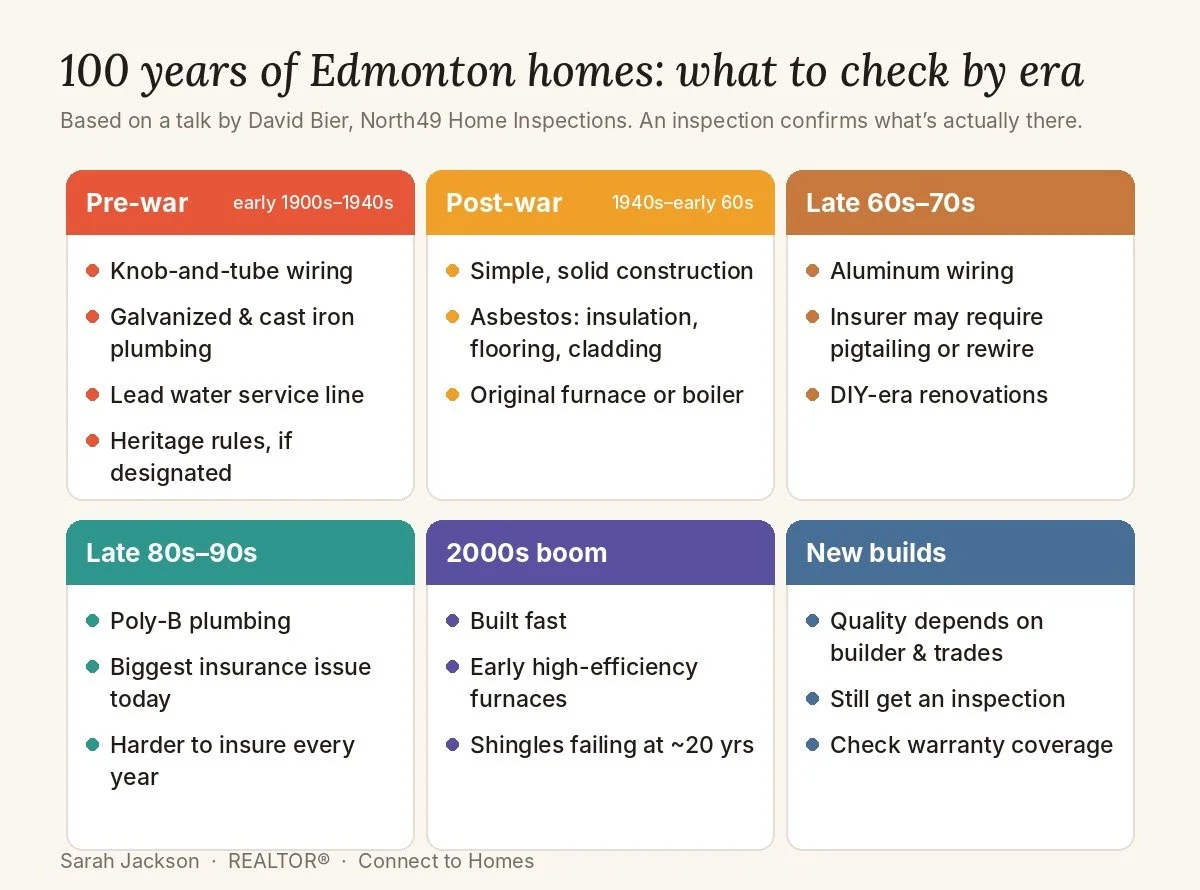
Pre-war homes (early 1900s to the 1940s)
These are the character homes in Edmonton's oldest neighbourhoods: big yards, mature elm trees and original woodwork. They tend to attract two kinds of buyers: people who know exactly what they're getting into and have a renovation budget, and first-time buyers who fall in love with the charm.
What you can't see on a showing is usually inside the walls and under the ground:
Knob-and-tube wiring: ungrounded wiring on ceramic knobs. Many insurers won't cover it until it's replaced.
Galvanized and cast iron plumbing: corrodes from the inside, which shows up as low water pressure, discoloured water and leaks.
A lead water service line: EPCOR says homes built before 1960 are a key indicator of a lead service line. Customers with one, or who suspect one, can get yearly water testing at no charge (EPCOR).
Heritage rules: if a home is a designated historic resource, you may not be able to replace original windows, remove a porch or add on the way you'd planned. Check before you buy, not after.
Budget for: rewiring, re-plumbing, a sewer line camera scope, and a contingency for surprises.
Post-war homes (1940s to the early 1960s)
After the war, Edmonton built simple, practical homes: the classic bungalows in many mature neighbourhoods. As David puts it, simple things work. These homes are usually straightforward to inspect, and some still have their original furnaces or boilers, built like tanks and still running.
The catch is asbestos. Good building materials were scarce after the war, and asbestos was used widely: in insulation, floor coverings, and interior and exterior cladding. It's generally safe when left alone, but renovation is another story. David's example: a buyer with a $100,000 renovation budget can lose half of it to asbestos remediation before the real work starts.
Ask whether any asbestos testing or abatement has been done, and get the paperwork.
Look in the attic for vermiculite: loose, pebble-like, grey-brown or silvery-gold insulation. Much of the vermiculite sold in Canada until 1990 may contain asbestos. Don't disturb it; have it tested.
If you plan a big renovation, get asbestos testing done early so the budget is realistic.
Late 1960s and 1970s homes
This is the era of aluminum branch wiring. The wiring itself isn't automatically dangerous, but insurers have their own rules. Depending on the company, they may:
require pigtailing (adding short copper connections at outlets and switches),
require a full rewire,
insure it at a higher premium, or
decline coverage.
David's prediction: it isn't getting easier. Insurance rules around older systems tend to tighten over time. Homes from this era may also have some, let's say, creative do-it-yourself renovations, so look closely at anything that's been redone.
Late 1980s and 1990s homes
For this era, the big one is Poly-B (polybutylene) plumbing, which David calls the biggest problem for insurance companies right now. Poly-B reached Canada by 1978 and was widely used from about 1985 to 1997. The Canadian plumbing code removed it in 2005, and the Government of Alberta estimates about 148,000 Alberta homes still have it (Alberta REALTOR®).
How to spot it: grey plastic pipe (sometimes black, blue, red or silver) stamped "PB" (for example, "PB2110"), usually with copper crimp fittings at the corners. Look in the utility room and under sinks.
Why it matters: it can turn brittle and split without warning. Insurers may charge more, change coverage, require replacement within a set time, or decline.
The trend: ten years ago, insuring a 90s home with Poly-B was routine. Today it's a problem, and David expects it to be even harder for people who buy these homes now and sell them later.
What to do: ask for replacement receipts, get a plumber's quote during your inspection condition, and call your insurer before conditions come off.
2000s boom homes
Homes built in Edmonton's 2000s boom went up fast. Two things to watch:
Early high-efficiency furnaces: these were among the first of their kind, and many are now due for replacement. Ask the install year and service history.
Shingles: some roofing used in this era was expected to last 35 to 40 years, but David's team sees many needing replacement after about 20. Ask when the roof was last done, and about any hail claims.
New builds: still get an inspection
Today's materials and technology are better than ever, so why inspect a brand-new home? Because the house is only as good as the builder and the trades they hire. David's team has inspected more new builds in the last year and a half than ever before, and they find real issues with some builders across the city. Others, he notes, build surprisingly well.
Get an independent inspection before possession, and again before your warranty deadlines.
Research the builder: reviews, past communities, and how they handle warranty claims.
Have your own REALTOR® on your side, even when buying directly from a builder.
Any era: radon and the big-ticket items
Radon is an invisible, odourless radioactive gas that comes up from the ground, and it is the leading cause of lung cancer in non-smokers. A Health Canada survey found 7% of Alberta homes above the federal guideline of 200 Bq/m³, with some communities testing much higher (Take Action on Radon). New or old, the only way to know is a long-term test of at least 3 months, ideally over the heating season.
Asphalt shingle roof: typically 15–25 years, often less after Alberta hail.
Furnace: typically 15–25 years.
Hot water tank: typically 10–15 years. Check the date on the label.
Windows: typically 20–30 years. Fogging between panes means the seal has failed.
Sewer line: for older homes, add a camera scope to your inspection. It's a small cost compared with replacing a collapsed line.
Watch the full talk
David Bier's full 10-minute presentation is worth a watch if you're shopping for an older home: 100 Years of Homebuilding in Edmonton: What Buyers and REALTORS Should Know Before Making an Offer.
Your older-home checklist
☐ Noted the year built and what has been updated (with receipts or permits)
☐ Asked about knob-and-tube or aluminum wiring and the panel size
☐ Looked for Poly-B (grey pipe stamped "PB")
☐ Asked about asbestos testing and checked the attic for vermiculite
☐ For pre-1960 homes, asked EPCOR about a lead service line
☐ Checked for heritage designation if it's a character home
☐ Dated the roof, furnace and hot water tank
☐ Booked an inspection with a sewer scope for older homes
☐ Called my insurer before conditions came off
☐ Planned a long-term radon test after possession
This is 1 of the 8 things I check with every buyer. Read the others: Flood Map and Property Taxes.
Frequently asked questions
What should I look for when buying an older home in Edmonton?
Start with the year built. Pre-war homes may have knob-and-tube wiring, galvanized plumbing and lead service lines; post-war homes may contain asbestos; 1960s–70s homes may have aluminum wiring; and 1980s–90s homes may have Poly-B plumbing. A home inspection with a sewer scope confirms what's actually there.
Can I get home insurance with Poly-B or aluminum wiring in Alberta?
Often, but not always. Insurers may charge more, require pigtailing, rewiring or re-plumbing within a set time, or decline coverage. Call your insurer with the home's details before your conditions come off.
How do I know if a house has Poly-B plumbing?
Look at exposed pipes in the utility room and under sinks. Poly-B is usually grey plastic stamped "PB" (such as PB2110) with copper crimp fittings. Homes built from about 1980 to 1998 are the most likely to have it.
Does a new build need a home inspection?
Yes. Materials are better than ever, but quality depends on the builder and the trades they hire. An independent inspection before possession and before warranty deadlines helps catch issues while the builder is still responsible.
Is radon a problem in Edmonton?
Radon is found across Alberta. A Health Canada survey found 7% of Alberta homes above the federal guideline. The only way to know is to test, ideally with a long-term test of at least 3 months.
Sources
General information only, not legal, insurance or inspection advice. Confirm details for any specific property with your insurer and a qualified home inspector.